The landscape of visual communication has undergone a profound transformation. As we navigate through 2026, organizations across every sector are abandoning static posters and outdated display screens in favor of dynamic digital signage networks. Yet, deploying high-definition screens is only half the battle. The true challenge of modern digital signage content management has always been maintaining absolute freshness. Updating menus, aggregating news, tracking job boards, and syncing local events manually is an ongoing administrative drain.
Fortunately, the integration of artificial intelligence in digital signage has completely rewritten the rulebook. Modern software tools equipped with advanced AI features eliminate the manual labor of content updates, ensuring that displays reflect real-world changes instantly. By adopting an intelligent digital signage solution, enterprises can elevate their signage deployments, transform their communication strategies, and deliver a seamless digital signage experience that keeps audiences thoroughly engaged.
Why Traditional Digital Signage Fails Without Artificial Intelligence
For years, managing digital displays meant tedious manual entry. You update a cafeteria menu on Monday, but by Thursday, items change or prices shift. You extract operating hours from a third-party website, only for that site to alter its layout and break your integration. You collect a news feed, and by the afternoon, the stories are stale and irrelevant. This continuous friction is why many organizations struggle to scale their signage networks effectively.
Traditional digital signage relies heavily on static files, manual scheduling, and rigid templates. When a business relies entirely on human intervention to update screens, content inevitably becomes outdated. Outdated information erodes audience trust, rendering displays far less effective. To overcome this hurdle, organizations are turning toward cloud-based digital signage platforms enhanced by generative AI and edge AI models.
By leveraging an advanced digital signage platform, teams can automate their content workflows completely. Instead of manually copying and pasting information, administrators can deploy an AI tool that casts a wide net across web sources, extracts accurate parameters, and formats the output directly for display signage.
The Core Engines of Next-Generation Digital Signage Management
The latest iteration of intelligent signage relies on two primary data-fetching mechanisms that redefine how content flows into a digital display:
AI Datasource: This mechanism casts a wide net via targeted web searches, analyzing vast amounts of unstructured data to retrieve precisely what you need based on specified parameters. You simply prompt the system for the information you want, and the AI filters through the noise to find relevant insights.
AI Webscraper: When you require razor-sharp accuracy from a specific webpage, the webscraper scans that exact URL to extract predefined parameters. Unlike broad data sources, webscrapers can also capture images and structural media elements, making them ideal for precise visual updates.
These capabilities form the backbone of modern digital signage solutions, allowing organizations to maintain fresh, dynamic content without lifting a finger. Below are the most impactful automation use cases that organizations are implementing right now.
Transforming Local Events and Community Feeds
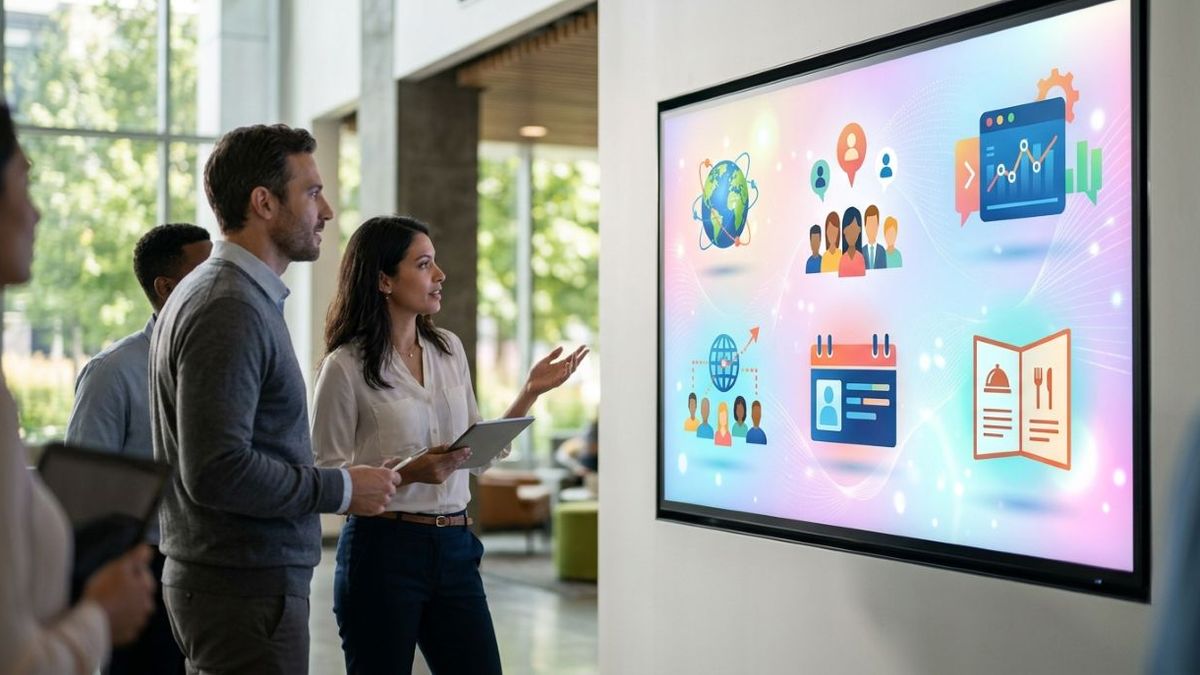
Promoting community engagement within corporate campuses, office lobbies, and public spaces requires a steady stream of fresh, relevant happenings. Manually researching local events consumes hours of weekly labor, often resulting in missed opportunities or expired notices remaining on screen.
By setting up an automated AI datasource, organizations can effortlessly pull upcoming local events within a specific geographic radius. A typical prompt might look like this:
Create a datasource that pulls upcoming local events in our area within a 3-mile radius. Show event name, date, time, and brief description. Update every day. Skip corporate events, focusing purely on community, arts, and entertainment.
This automation runs web scraping across regional event calendars every few hours, filters out unwanted commercial content, harmonizes date and time formats, and eliminates duplicate listings. A corporate campus cafeteria utilizing this setup can automatically display six to eight fresh local events weekly, saving hours of manual research while keeping employees informed and connected.
Automating Restaurant Menus and Dining Room Displays
Food service operations face constant menu fluctuations, pricing adjustments, and inventory changes. Keeping digital menu boards synchronized with point-of-sale systems or website menus is critical for customer satisfaction and regulatory compliance.
Implementing an AI-driven digital signage system allows dining facilities to pull live menu data directly from source websites or databases. A standard automation prompt instructs the system to:
Pull the lunch menu from the target restaurant website, extracting items, prices, and descriptions. Update daily at 10:30 AM. Adapt automatically if the website structure changes, and flag any price changes greater than 15% since yesterday.
Daily web scraping ensures prices never go stale on display. Adaptive parsing guarantees that even if a restaurant redesigns its web layout, the AI successfully locates and formats the menu data. Furthermore, automated price-change alerts help administrative teams manage budgeting and internal communications seamlessly, saving dozens of hours of manual transcription work annually.
Dynamic News Aggregation and Market Intelligence
Lobby screens and corporate communication channels thrive on up-to-the-minute news, financial updates, and industry insights. However, manual curation of news feeds is time-consuming and prone to human bias.
Using a data-driven digital signage approach, organizations can aggregate news headlines from multiple authoritative sources instantly. A well-crafted prompt directs the system to:
Pull news headlines about the target industry from five major news sources. Show only articles published in the last 8 hours. Extract headline, source, publication time, and a 1-2 sentence summary, ranking them by relevance to specified keywords.
Multi-source scraping combined with keyword-based ranking ensures that audiences always see the most pertinent developments first. Time-based filtering discards outdated stories automatically, while robust deduplication prevents the same headline from appearing across multiple feeds. This maintains high viewer credibility and transforms routine lobby screens into dynamic hubs of market intelligence.
Streamlining Career Portals and Job Boards
During heavy recruitment periods or campus career fairs, displaying open job listings on digital screens is an exceptionally effective outreach strategy. However, keeping those listings synchronized with internal human resources databases can overwhelm recruitment teams.
Automated signage tools allow organizations to pull open job listings directly from corporate career pages or municipal portals. By configuring a prompt to filter for positions posted within the current week, the system handles status tracking automatically—distinguishing between newly opened roles and filled positions. Visual highlights draw candidate attention to fresh postings, ensuring that prospective applicants always view accurate employment opportunities without requiring manual recruiter intervention.
Real Estate Listings and Property Showcase Networks
Commercial and residential real estate brokerages rely heavily on visual displays in storefronts and office windows to attract prospective buyers. Keeping property inventories current across multiple physical displays is traditionally an administrative bottleneck.
Through cloud-based software solutions, brokerages can connect their digital displays directly to multiple listing services and real estate databases. The system automatically filters properties by price, location, and square footage, highlights newly added listings, and purges sold properties from rotation. This automated freshness drives higher foot traffic and encourages broader signage deployments as agents witness the direct positive impact on client engagement.
Real-Time Sports Scores and Employee Engagement
Break rooms and communal office spaces benefit greatly from casual, engaging content that fosters workplace camaraderie. Sports scores and standings are a perennial favorite among employees.
By establishing an automated sports data feed, screens can display recent game results and local team standings updated in real time. This hands-off approach requires zero manual score entry, guarantees accurate data, and naturally sparks positive conversations and engagement among staff members during breaks.
Daily Specials, Promotions, and Flash Inventory
Retailers and quick-service restaurants frequently run limited-time promotions, happy hour discounts, and flash sales. Communicating these fleeting offers across multiple display signage units requires instant synchronization.
An AI-powered digital signage workflow can pull active promotions directly from inventory management systems, sorting discounts so that the highest-value deals appear prominently at the top of the screen. Furthermore, when a promotional item reaches its daily sales limit or sells out entirely, the system tracks inventory in real time and automatically removes the promotion from active rotation, eliminating the risk of unfulfilled customer expectations.
Best Practices for Maximizing Your Digital Signage Network
To achieve optimal results when deploying automated data sources across your signage networks, consider the following strategic guidelines:
- Start with a Single Source: Choose the specific content feed that saves the most manual labor or delivers the highest immediate value to your audience. Once you master its configuration, expand outward to additional screens and feeds.
- Calibrate Refresh Schedules Carefully: Match your update intervals to the nature of the content. Fast-moving news feeds require frequent hourly refreshes, whereas job boards or corporate announcements can safely update every twelve hours.
- Leverage Advanced Filtering Rules: Utilize AI-driven filtering parameters to organize content by engagement levels, specific dates, or custom category logic, ensuring your screens remain clean and uncluttered.
- Anticipate Operational Edge Cases: Build conditional logic into your setups. If a featured partner restaurant temporarily closes or pauses operations, the system should recognize the disruption and halt data extraction automatically.
The Future of Visual Communication
The evolution of visual displays in 2026 proves that content freshness is the ultimate currency of effective communication. By embracing intelligent automation, organizations no longer need to compromise between striking visual design and up-to-the-minute accuracy.
Whether you are managing enterprise-grade corporate communications, retail promotions, or public information networks, integrating advanced AI tools into your display strategy guarantees that your audience sees reality reflected in real time. Automate your data sources today, eliminate administrative friction, and let your screens do the work for you.