
Golf has always been a sport defined by rich tradition, remarkable achievements, and precise scorekeeping, with a strong emphasis on maintaining an accurate ranking system that updates automatically. Whether at high-stakes championship tournaments or weekly member competitions, leaderboards serve as the beating heart of competitive golf, often featuring the club's logo prominently on a customizable free leaderboard. They communicate standings, build excitement, and celebrate excellence through gamification techniques, similar to strategies used in esports. Yet, many golf courses still rely on outdated scoreboard systems that fail to engage modern golfers, struggle with real-time updates, or neglect the rich history of club achievements, missing opportunities to incorporate dynamic and engaging ranking displays.
This comprehensive guide explores the evolution of modern golf course leaderboard displays, including how they can be fully customizable to meet club needs. From tournament-specific digital solutions to permanent recognition systems that celebrate club history, we will explore how implementing the right technology can inform, inspire, and elevate your entire golf operation.
The Golf Leaderboard Challenge at Modern Courses
Walk through most traditional golf clubhouses and you will likely notice a familiar pattern: championship trophies occupy cases collecting dust, historic photos scatter across walls without context, and tournament results from last season have already faded from memory. Meanwhile, out on the course during active tournaments, manual scoreboards require constant staff attention, making it difficult to update scores in real time, which can be resolved with an automated tracker. They display limited information and become instantly outdated the moment players complete a new hole, which is why an update in real time is crucial.
This disconnect between rich golf history and limited recognition visibility creates missed opportunities for sales managers to showcase deals closed through tournament participation.
The Limitations of Tradition
- Manual Labor: Customization of leaderboards can reduce the need for manual labor in updating scores, allowing sales teams to focus on their quotas. Traditional paper postings and manual boards require dedicated staff to constantly monitor scores and physically update the board, pulling personnel away from other vital tournament duties.
- Limited Visibility: Traditional methods provide limited visibility, whereas modern approaches can utilize a customizable template and shareable formats for better engagement, much like classroom leaderboards that promote friendly competition. Spectators and non-competing members are forced to walk inside the clubhouse repeatedly just to check standings, limiting their engagement with the tournament experience and making it difficult to create a leaderboard.
- Space Constraints: Limited space can be optimized with a fully customizable leaderboard that fits the venue's design. Physical plaques and trophy cases consume valuable wall space. Eventually, capacity constraints force uncomfortable decisions about which achievements deserve permanent display and which older awards must be removed to make room for new ones.
Without modern systems to preserve tournament history, decades of competitive golf heritage vanish, forgotten except by the participants who happened to play that day, making it crucial to embed historical data into the current ranking system.
Modern Tournament Leaderboard Solutions
Successful golf tournaments require systems that inform participants, engage spectators, and enhance the overall competitive experience through timely, accurate presentation of scores and rankings.
Real-Time Digital Tournament Boards
Contemporary tournament leaderboards integrate directly with digital scoring systems, displaying real-time updates as players complete holes, utilizing an online leaderboard maker without requiring manual staff intervention. These systems pull data seamlessly from handheld devices, mobile apps, or integrated golf GPS systems, making it easy to track progress during competitions.
Key Features of Effective Tournament Displays: Customization options that allow for embedding code for real-time updates.
- Live scoring updates: The integration of technology allows live scoring updates that keep spectators informed while the leaderboard updates automatically. Automatic refreshes as new scores post, eliminating manual delays, allow for an efficient update in real time, ensuring that the ranking display is always current.
- Hole-by-hole detail: This information can be displayed on TVs for enhanced viewer engagement. Individual hole scores showing exactly where players gained or lost strokes.
- Dynamic standings: Dynamic standings can be displayed on a full-screen TV display to keep players and spectators informed about real-time score changes. Real-time leaderboard positions adjusted automatically as scores fluctuate.
- Pace of play indicators: Visual cues showing which groups are on which holes can be enhanced through gamification to engage spectators more effectively, especially when combined with a tracker and shareable progress bars that resemble esports leaderboards.
Modern software supports multiple tournament formats—including stroke play, match play, stableford, and scrambles—automatically calculating the appropriate standings for each unique competition type.
Large-Format LED Displays and Mobile Accessibility
For premier tournaments where spectator engagement is paramount, large-format LED displays provide unmatched visibility for crowds gathered around finishing holes or championship ceremonies. These premium displays offer readability from significant distances while supporting rich graphics that traditional scoreboards simply cannot match, enhancing the overall ranking experience for spectators.
Complementing these physical displays, mobile-accessible leaderboards enable participants and spectators to monitor tournaments from anywhere. Clubs can simply share QR codes or shortened URLs that open directly to live leaderboards, making tournament tracking effortless for a tech-savvy audience and enhancing their fitness challenge experience.
Preserving Heritage: Permanent Digital Recognition Systems
Beyond temporary tournament leaderboards, golf courses benefit enormously from permanent recognition systems that celebrate club history, honor member accomplishments, and preserve institutional heritage.
Interactive Digital Displays
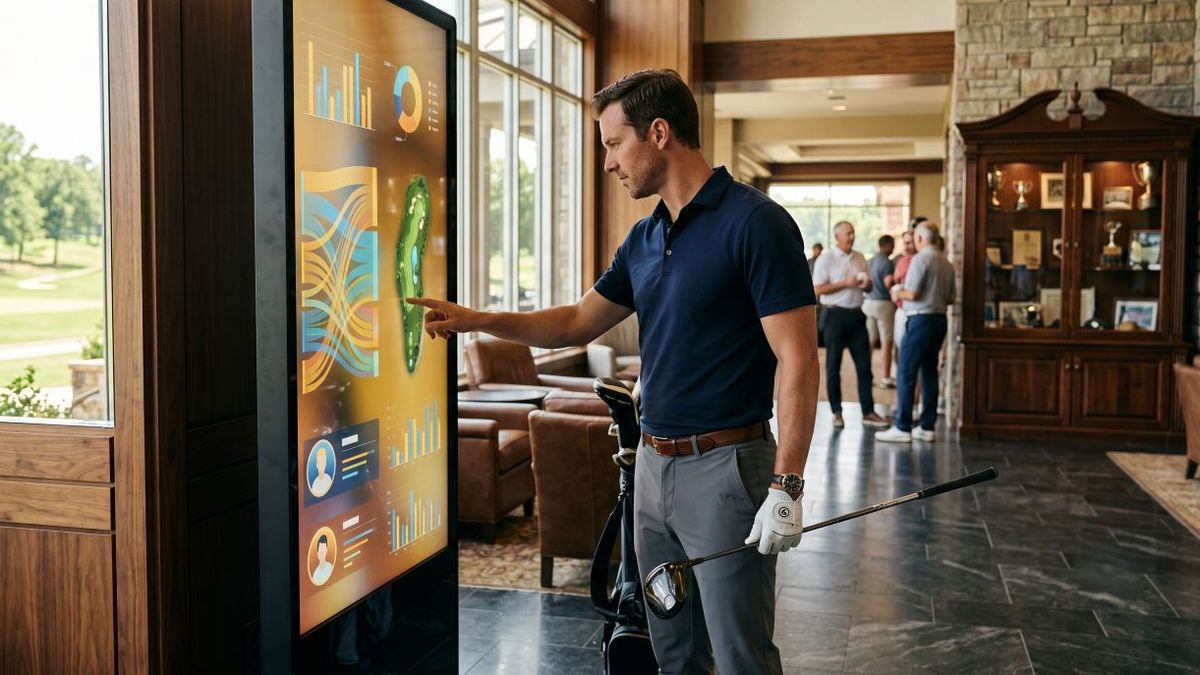
Modern golf clubs are increasingly implementing interactive touchscreen displays that transform static trophy cases into engaging, searchable, and virtually unlimited recognition platforms, effectively building a leaderboard. Positioned in high-traffic clubhouse areas, these large-format screens enable comprehensive recognition that traditional approaches cannot accommodate, especially when used as a custom leaderboard.
What to Feature on Digital Recognition Displays: Consider integrating a custom leaderboard that highlights key player statistics and incorporates score changes to keep the audience informed.
- Club Championship History: This can be enhanced by linking to a digital archive or providing a leaderboard via a link for easy access. Complete records of every club champion across all divisions, searchable by year or division, complete with photographs and final scores, can be displayed on a leaderboard that updates automatically.
- Course Records: A comprehensive spreadsheet of course records can be created to track player performance over time. Comprehensive documentation showing the lowest scores across various tees, age divisions, and gender categories, highlighting the golfer’s story, weather conditions of that historic day, and embedding the club's logo for branding.
- Hole-in-One Achievements: An archive of all aces recorded at the course, including the club used, distance, witnesses, and commemorative photographs, can be enhanced with a URL linking to the online leaderboard that updates automatically.
- Historical Milestones: This section can include a dynamic tracker of past achievements in golf history. Significant club events, course renovations, and institutional achievements that define the club's identity and preserve institutional memory can be effectively showcased on a leaderboard maker.
The Hybrid Approach
For clubs with cherished physical trophy cases or traditional plaque walls, digital systems can enhance rather than replace these installations by integrating participant names and achievements into the displays. Complementary digital displays positioned near physical trophies provide interactive context, detailing the stories behind the championships that physical space constraints prevent presenting on traditional plaques.
Note: A hybrid approach respects tradition while addressing modern engagement expectations, utilizing both a traditional leaderboard and a free leaderboard maker for customizable digital displays. Physical trophies satisfy members who value tangible awards, while digital displays provide expanded information and searchable access.
Implementation and Content Strategy
Successfully implementing modern leaderboard and recognition displays requires thoughtful planning, strategic location choices, and robust content management.
Strategic Display Positioning
To maximize member engagement without disrupting clubhouse aesthetics, displays should be placed in optimal viewing environments. Ideal locations feature high traffic volume—such as near the pro shop checkout, locker room entrances, or main lobby spaces—and possess the necessary electrical and strong network infrastructure to ensure real-time content updates.
Digitization and Content Development
Compelling recognition displays require rich historical content, which can be enhanced through fundraising campaigns to gather more resources. This involves researching past championship records, digitizing physical photographs and analog materials, and creating engaging profiles for past champions, potentially displayed on a free leaderboard.
Many clubs approach this iteratively, launching displays with recent achievements and systematically expanding historical content over time as digitization projects progress, often in conjunction with sales competitions. This phased approach enables immediate display activation while gradually building a comprehensive historical database, enhancing the customization of tournament experiences.
Ongoing Content Management
Unlike static physical displays, digital recognition systems require continuous content management, allowing for real-time updates and score changes. Successful programs establish clear workflows for post-tournament updates, real-time achievement additions (like a weekend hole-in-one), and seasonal content adjustments. Cloud-based management systems empower authorized staff to update displays from any device seamlessly, ensuring the content remains fresh, relevant, and engaging, which is vital for effective fundraising initiatives.
Investment Value and Future Trends
When evaluating leaderboard and recognition display investments, modern golf clubs must consider the broader returns justifying the technology expenditures, including the impact on sales teams and member satisfaction.
Return on Investment (ROI) Dimensions: When assessing the ROI of leaderboard technology, consider how board updates in real time can improve overall tournament experiences.
- Member Engagement: Engaging members can be enhanced through a sales leaderboard that showcases top performers and their achievements. Displays create natural gathering points where members explore club history and celebrate peers, deepening community connections and aiding in member retention through the use of a free online leaderboard maker.
- Operational Efficiency: Automated leaderboards drastically reduce the staff time previously spent manually updating scoreboards, enabling personnel to focus on high-level hospitality and member service while allowing them to share the live leaderboard with participants.
- Historical Preservation: The integration of modern technology is essential for maintaining a comprehensive record of past rankings and achievements on a fully customizable leaderboard. Digital systems permanently protect club heritage that might otherwise fade as physical materials deteriorate and institutional memory gradually erodes, ensuring that achievements are easily shareable and accessible.
Looking to the Future
Golf leaderboard technology continues to evolve rapidly, incorporating new metrics to improve the accuracy of real-time updates. Advanced platforms are beginning to incorporate predictive analytics—projecting final scores based on current performance patterns to build spectator anticipation, similar to features found in a live leaderboard. Furthermore, the integration of social sharing capabilities allows members to post their digital achievement cards directly to their social media networks, effectively promoting the club's brand. This not only celebrates the individual but organically markets the club’s standard of excellence to a wider audience.
Conclusion
Golf leaderboards serve functions far beyond simple scorekeeping. During active tournaments, they inform, engage, and elevate the competitive atmosphere using a live leaderboard to keep spectators informed, similar to how reading challenges keep participants motivated. As permanent clubhouse installations, they celebrate outstanding achievements, preserve vital heritage, and strengthen the community bonds that transform a simple recreational facility into a club defined by tradition and shared excellence.
Modern digital display technology enables golf courses to accomplish recognition objectives that manual scoreboards and wooden plaques simply cannot match, including showcasing participant names and their rankings. By embracing these innovative systems, golf operations can provide real-time excitement today while permanently honoring the rich institutional heritage of tomorrow, akin to how podium finishes are celebrated in competitive events.